août 25, 2025
|8 minutes

Dans le marketing B2B, les performances sont constamment passées au crible, pourtant une part importante des ressources semble disparaître dans une boîte noire. Une étude de Forrester[1] révèle une dure réalité : les CMO (Directeurs Marketing) signalent qu’en moyenne, 25 % de leur budget technologique ne parvient pas à générer le ROI attendu. Il ne s’agit pas d’une simple ligne budgétaire ; c’est un frein massif à la croissance potentielle.
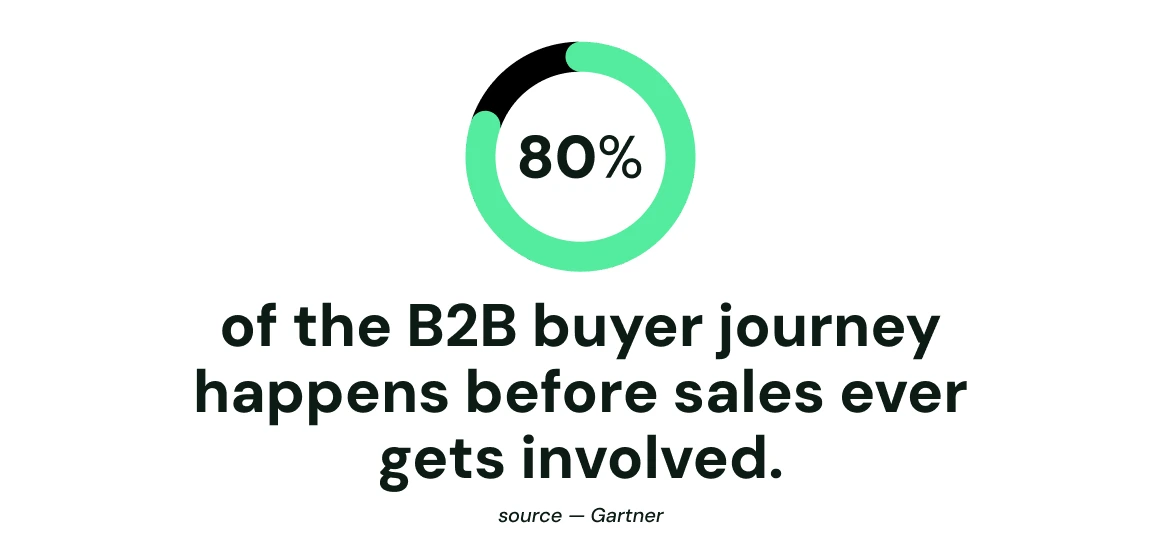
Pour aggraver les choses, Gartner[2] rapporte que les acheteurs B2B effectuent désormais environ quatre-vingts pour cent (80 %) de leur parcours de manière indépendante avant même de contacter un délégué commercial.
Cela signifie que la partie la plus critique de l’entonnoir de conversion — où les prospects sont gagnés ou perdus — se déroule numériquement et, souvent, de manière invisible. Vos analyses actuelles peuvent vous montrer ce qui s’est passé, mais elles ne peuvent pas expliquer le pourquoi crucial derrière ces chiffres. C’est l’angle mort par lequel les revenus s’échappent. Il est temps d’adopter une nouvelle approche.
L’Intelligence Artificielle (IA) introduit un nouveau paradigme pour l’analytique. Elle va au-delà des données descriptives (ce qui s’est passé) pour fournir des insights diagnostiques et prescriptifs (pourquoi cela s’est passé et ce qu’il faut faire). L’analytique par l’IA n’est pas juste un tableau de bord supplémentaire ; c’est un moteur de diagnostic pour l’ensemble de votre entonnoir de revenus. Elle est conçue pour identifier et colmater les fuites avec une précision basée sur les données.
Cet article explore comment appliquer l’IA comme levier stratégique pour repenser votre entonnoir de conversion de A à Z. Nous ne discuterons pas ici des analyses web basiques. Nous explorerons plutôt cinq transformations critiques que l’IA apporte à l’Optimisation du Taux de Conversion (CRO) et à l’Expérience Utilisateur (UX) :
Passons de la simple observation de l’entonnoir à l’ingénierie de son succès.
Les plateformes d’analyse traditionnelles excellent pour décrire ce qui s’est passé. Elles peuvent vous indiquer votre taux de rebond, votre temps passé sur la page et le taux de conversion d’une page de destination spécifique. Il s’agit de données descriptives : un instantané d’événements passés. Là où elles échouent, c’est dans l’explication du « pourquoi » derrière ces chiffres, laissant votre équipe interpréter manuellement les données et formuler des suppositions éclairées.
L’analytique par l’IA introduit une nouvelle couche cruciale : la capacité de diagnostiquer les problèmes automatiquement. Elle agit comme un « data scientist » infatigable, passant au crible des millions de points de données pour trouver des modèles et des corrélations invisibles à l’œil humain. Selon une étude de McKinsey[3], les organisations qui intègrent ce type de prise de décision basée sur les données et propulsée par l’IA dans leurs processus de base constatent des rendements exceptionnels et un avantage concurrentiel significatif.
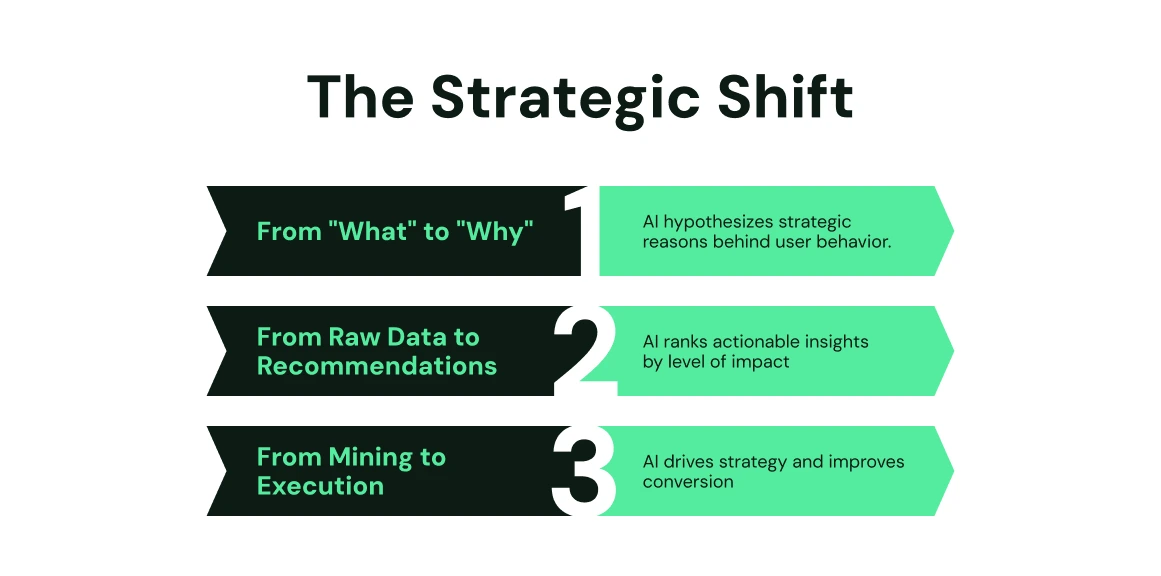
Du « Quoi » au « Pourquoi »
Un moteur d’analyse propulsé par l’IA peut analyser des milliers de sessions d’utilisateurs et émettre des hypothèses sur le pourquoi. Par exemple, il pourrait générer un insight spécifique tel que : « Les utilisateurs d’Allemagne sur le navigateur Firefox sont 80 % plus susceptibles d’abandonner le formulaire lorsqu’ils atteignent le champ ‘Numéro de téléphone’, ce qui suggère un problème potentiel de confidentialité des données ou un problème d’UX spécifique à ce navigateur. »
De la surcharge de données aux insights prescriptifs
Au lieu de présenter des données brutes, l’IA fait remonter des recommandations priorisées et exploitables. Elle ne vous donne pas seulement une montagne d’informations ; elle vous remet une courte liste stratégique des plus grandes opportunités d’amélioration de la conversion, classées par impact potentiel. Ce changement fondamental libère un temps précieux pour votre équipe. Elle peut passer de l’exploration de données à la stratégie et à l’exécution, en agissant sur des insights de haute fiabilité plutôt que de débattre d’hypothèses.
L’un des plus grands défis du marketing B2B est le parcours client fragmenté. Un seul prospect peut interagir avec votre marque sur plusieurs appareils et canaux au fil de plusieurs mois. Il peut voir une publicité LinkedIn sur son GSM, lire un article de blog sur son ordinateur portable et assister à un webinaire sur sa tablette. L’analytique traditionnelle peine à connecter ces points de contact disparates, vous laissant avec une vue incomplète et trompeuse du chemin de conversion.
L’IA excelle à recoudre ces fragments. En intégrant les données de vos plateformes de gestion de la relation client (CRM), d’automatisation du marketing et d’analyse web, l’IA peut construire une vue unifiée de bout en bout du parcours du compte.
Véritable attribution multicanal : Vous pouvez enfin voir comment les différents canaux travaillent ensemble pour influencer la conversion. L’IA peut révéler que, bien que l’e-mail marketing puisse s’attribuer le mérite du clic final, la sensibilisation initiale générée par une campagne publicitaire ciblée était une condition préalable critique au succès.
Identification des parcours à forte valeur : L’IA peut analyser des milliers de chemins de conversion pour identifier les parcours les plus efficients et efficaces. Par exemple, elle pourrait découvrir que les prospects qui regardent un webinaire spécifique puis lisent une étude de cas particulière ont 5 fois plus de chances de se convertir. Cet insight vous permet de guider de manière proactive d’autres prospects sur ce chemin éprouvé à forte valeur ajoutée.
Élimination de la pensée en silos : Une vue unifiée décloisonne les silos de données entre les différentes équipes régionales ou fonctions marketing. Elle fournit une source unique de vérité sur la façon dont les clients interagissent avec votre marque à l’échelle mondiale, permettant une planification stratégique plus cohérente et intelligente.
Où exactement les utilisateurs sont-ils confus, frustrés ou perdus sur votre site web ? Trouver ces points de friction spécifiques est le cœur du travail de CRO. Manuellement, cela implique de regarder des enregistrements de sessions et d’analyser des cartes de chaleur (heatmaps) — un processus chronophage qu’il est impossible de réaliser à grande échelle.
L’IA automatise ce processus de détection des frictions. Elle peut analyser chaque session d’utilisateur individuelle pour identifier les modèles de comportement qui indiquent une frustration ou une confusion.
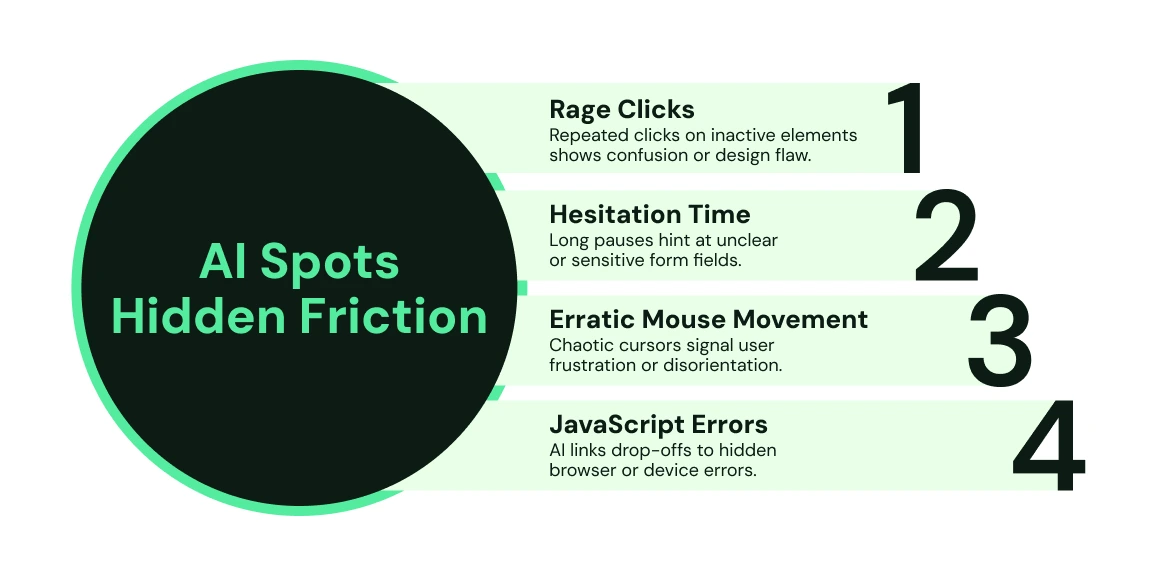
Crucialement, l’IA ne se contente pas de signaler le comportement ; elle fournit le contexte. Le système peut déclarer que « septante-cinq pour cent (75 %) des utilisateurs qui affichent des ‘clics de rage’ sur le tableau des prix sont sur des appareils mobiles », orientant immédiatement votre équipe UX vers un problème de conception responsive sur mobile. Il s’agit d’une analyse automatisée des causes profondes, ce qui accélère considérablement le cycle d’optimisation.
Optimiser un entonnoir marketing pour obtenir plus de leads n’est que la moitié de la bataille. Un moteur de revenus véritablement efficace doit également s’assurer que l’équipe commerciale se concentre sur les leads les plus susceptibles de se convertir en clients. Un grand volume de leads de mauvaise qualité peut être tout aussi dommageable qu’un faible volume de leads de haute qualité, car cela brûle de précieux cycles de vente et fait grimper les coûts d’acquisition de clients.
C’est ici que l’IA jette un pont critique entre l’optimisation marketing et l’efficacité commerciale grâce au lead scoring prédictif.
Les modèles traditionnels de lead scoring sont basés sur des systèmes statiques reposant sur des règles (par ex., +10 points pour un titre de Vice-Président, +5 pour le téléchargement d’un livre blanc). Le scoring propulsé par l’IA est dynamique et apprend avec le temps.
Il analyse les attributs et les comportements de tous vos anciens clients pour construire un modèle de ce à quoi ressemble véritablement un prospect à forte valeur ajoutée. Il peut identifier des schémas subtils — comme la combinaison spécifique de pages qu’un utilisateur visite — qui sont hautement prédictifs d’une intention d’achat. Cela vous permet de prioriser les leads avec une précision scientifique.
Un lead avec un score de conversion prédictif de nonante pour cent (90 %) peut être rapidement transmis directement à vos account executives les plus expérimentés, tandis qu’un lead avec un score de 30 % peut être placé dans une campagne automatisée de « nurturing » à long terme. Cela optimise l’ensemble du chemin de conversion, et non seulement la partie marketing. Cela transforme la relation ventes-marketing, passant d’un état de tension à un alignement stratégique axé sur l’objectif commun d’une croissance prévisible des revenus.
Les tests A/B sont un élément fondateur du CRO. Cependant, c’est un processus lent et méthodique qui ne peut tester qu’une seule variable à la fois. Pour les sites web complexes avec des dizaines d’éléments potentiels à optimiser, cette approche peut prendre des mois, voire des années, pour produire des résultats significatifs. L’IA transforme ce paysage en permettant une expérimentation plus intelligente et plus rapide.
Tests multivariés propulsés par l’IA : L’IA peut tester des dizaines de combinaisons d’éléments (titres, images, couleurs de boutons, champs de formulaire) simultanément. Elle peut traiter rapidement les résultats pour identifier non seulement le meilleur élément unique, mais aussi la combinaison optimale d’éléments pour différents segments d’utilisateurs.
Optimisation continue : Au lieu de lancer un test, de choisir un gagnant et de s’arrêter, l’IA peut activer un état d’optimisation continue. Le système expérimente constamment de petits changements, apprend des résultats et alloue automatiquement plus de trafic aux variations les plus performantes.
IA générative pour la création d’hypothèses : Les capacités émergentes de l’IA peuvent même aider à générer de nouvelles idées sur ce qu’il faut tester. En analysant votre page existante et les points de friction identifiés, l’IA générative peut suggérer des titres alternatifs, des propositions de valeur reformulées ou des mises en page différentes, fournissant à votre équipe un flux constant d’idées basées sur les données pour alimenter le cycle d’expérimentation.
Cela fait passer une organisation d’une culture de tests périodiques à une culture d’optimisation continue et intelligente, créant un avantage concurrentiel puissant et durable.
L’entonnoir de conversion B2B n’est plus une « boîte noire » dont il faut s’accommoder. C’est un moteur qui peut être systématiquement analysé, diagnostiqué et repensé pour des performances maximales. L’analytique traditionnelle nous permettait d’observer ce moteur ; l’analytique par l’IA nous donne les outils pour en être l’ingénieur en chef.
En passant des données descriptives aux insights diagnostiques, en cartographiant le parcours client complet, en automatisant la détection des frictions, en priorisant les leads grâce au scoring prédictif et en adoptant une expérimentation intelligente, vous pouvez transformer votre entonnoir d’un simple parcours passif en une machine à revenus hautement efficace et prévisible.
L’exploitation de l’analytique par l’IA n’est pas seulement une tactique de CRO ; c’est un impératif stratégique pour stimuler une croissance durable et basée sur les données. Réaliser ce changement exige plus que de la technologie ; cela demande une nouvelle approche de la croissance. Il est maintenant temps de naviguer dans cette transformation et de construire les moteurs marketing ultra-performants de demain.
Please enter your email address so we can send you a one-time pass code and verify if you are an existing subscriber.
 BE
BE 

 BE
BE