août 23, 2025
|12 minutes de lecture

Your customer’s inbox is crowded. For B2B marketers, it’s the main place where you either get noticed or get deleted in seconds. For a long time, email has been the best way to get a return on your investment (ROI), and it still is—but it’s getting much harder to stand out. Your buyers, from the boss to the IT manager, are overwhelmed with emails. They are quick to delete anything that looks generic, and the old way of sending the same message to big lists of people no longer works. This is where Artificial Intelligence (AI) comes in.
AI in email marketing is about using smart technology to understand your customers on a deeper level and send them emails they actually want to read. Think of it as a very smart assistant for your marketing team. This assistant can look through huge amounts of customer information—like what they’ve clicked on, what they’ve bought, and who they are—to find patterns a person could never see. It then uses what it learns to help you automatically change your message, timing, and content for each individual. It’s the difference between shouting one message to a crowd and having a relevant, personal conversation with each customer, but on a huge scale. This is your simple guide for this new way of doing things. It’s for the B2B marketing leader who needs to make smart tech choices, the marketing strategist doing the day-to-day work, and anyone who knows the future of email isn’t just about automation—it’s about intelligence. Table of Contents
Integrating AI isn’t just about using new technology; it’s about gaining a significant competitive edge. The core advantages are clear, direct, and impact every level of your marketing efforts. 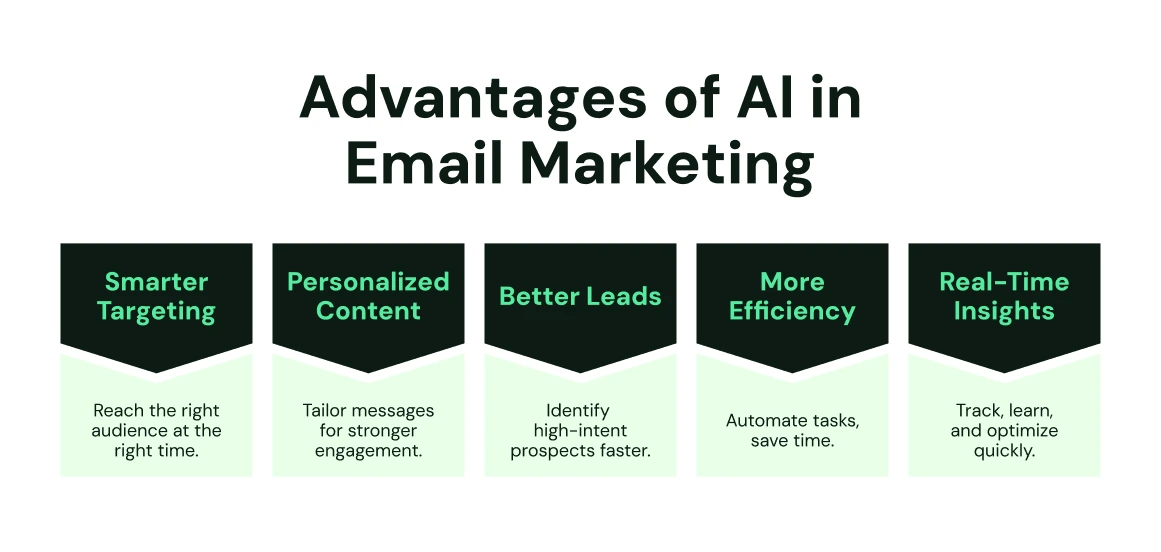 Deeper Customer Connection: AI moves you beyond generic communication. By tailoring content to individual needs and behaviors, you create emails that feel more relevant and personal, strengthening brand loyalty. Higher Quality Leads for Sales: Instead of sending every lead to sales, AI’s predictive scoring identifies who is ready to buy. This means your sales team spends less time chasing dead ends and more time closing deals with high-intent prospects. Increased Team Efficiency: AI automates the most time-consuming parts of email marketing, like list segmentation, A/B testing, and drafting routine copy. This frees your talented team to focus on strategy, creativity, and high-impact projects. Better, Faster Decision Making: AI provides data-backed insights into what’s working and what isn’t. This allows you to stop guessing and start making strategic decisions based on real-time performance data, optimizing your campaigns for success.
AI’s impact isn’t a single feature; it’s a fundamental upgrade to your entire email marketing engine. It’s about moving from educated guesses to data-driven certainty. Let’s dissect the key areas where this transformation is happening.
For a long time, « personalization » just meant adding a person’s first name to an email. That’s the bare minimum now. AI lets you go way beyond that and have real one-to-one conversations..
The old way was to group contacts into broad buckets. The new way is to let AI build dynamic, micro-segments in real time. Instead of just looking at firmographics like company size or industry, AI dives deeper, analyzing a rich tapestry of data points to find patterns you’d never spot on your own (MarTech). This includes: Behavioral Data: Who is clicking on what? Which whitepapers have they downloaded? What pages on your site have they visited? AI connects these dots to reveal true intent. Technographic Data: What technology stack does the target account already use? Knowing they use a competitor’s product or a complementary technology allows for incredibly targeted messaging.
This is where AI’s segmentation power comes to life. Instead of creating a dozen different email versions, you create one smart template. AI then populates that template with the most relevant content for each recipient as they open it (MarTech). Imagine an email sent to multiple stakeholders at a target account:
This isn’t just personalization; it’s a personalized experience, delivered at a scale that would be impossible for any human team to manage manually.
The best marketing seems to predict the future. AI gives you a tool that helps you predict what customers will do next by looking at what they’ve done in the past.
Forget old systems where you guess which leads are good. That model doesn’t work well anymore. AI looks at all your past customers who made a purchase and learns what they had in common. It then gives new leads a score based on how likely they are to buy. This helps your sales team stop wasting time and focus on the best opportunities (Salesforce).
When is the best time to send an email? Your guess isn’t good enough. AI tools can figure out the perfect time for each person on your list. By looking at when they’ve opened your emails before, the system sends your message when it’s most likely to be at the top of their inbox (OrangeOwl; Mailchimp).
For B2B SaaS and subscription models, retention is everything. AI can monitor subtle shifts in email engagement—a slow decline in open rates, a lack of clicks over several weeks—to flag an account as « at-risk » long before they cancel. This gives your customer success team a critical window to intervene. At the same time, AI can analyze the profiles of your most valuable, long-term customers and build « lookalike » audiences of new prospects who share those same winning characteristics (Salesforce).
Generative AI is the creative force multiplier your team has been waiting for. It’s here to eliminate writer’s block, automate tedious testing, and ensure your brand’s voice remains powerful and consistent.
Your subject line is the gatekeeper to your entire message. It has one job: get the email opened. Instead of your team brainstorming a few options, Generative AI can produce dozens of compelling variations in seconds. But it gets better. More advanced platforms combine this with predictive analytics to forecast which subject line will perform best with a specific audience segment, allowing you to run hyper-efficient tests that deliver immediate results (OrangeOwl; Mailchimp).
Frame AI as a creative assistant. It can:
This frees your human copywriters to do what they do best: high-level strategy, final polishing, and infusing the copy with the kind of human empathy AI can’t replicate. Furthermore, AI tools can analyze your drafts to ensure they align with your established brand guidelines, flagging a tone that’s too casual or a phrase that’s off-brand before it ever reaches a customer.
Adopting AI isn’t about flipping a switch. It’s a strategic shift that demands a thoughtful approach to protect your brand and your data. This section covers the keychallenges and the best practices to overcome them. 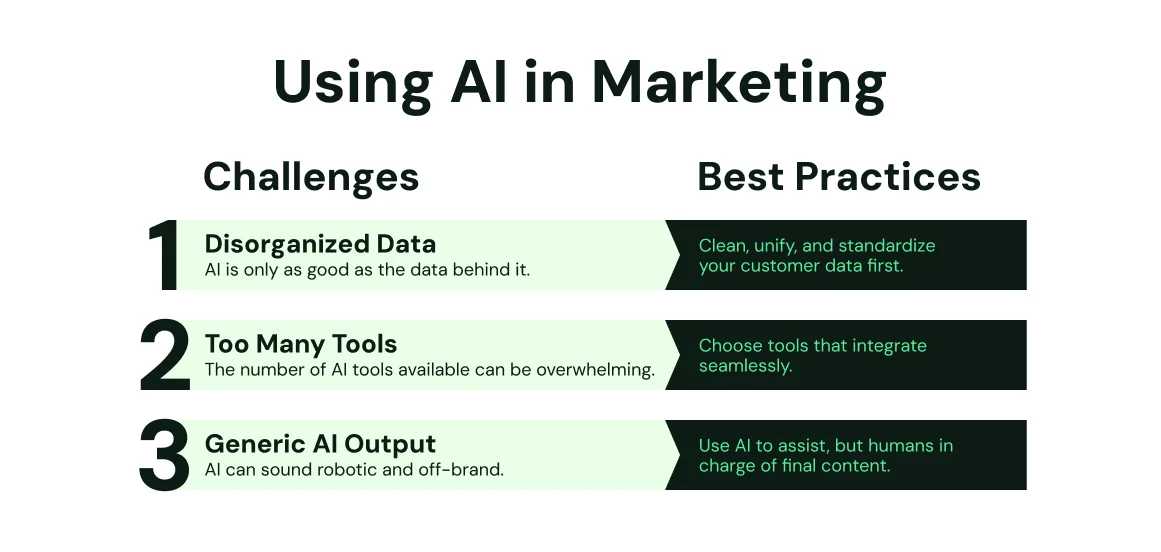
Messy and Siloed Data: Let’s be blunt: AI is only as smart as the data you feed it. The biggest challenge for many teams is a customer database that is disorganized, incomplete, and spread across multiple systems. If your data is a mess, your AI will produce messy results.
Choosing the Right Tools in a Crowded Market: The martech landscape is flooded with AI tools, and it can be overwhelming to separate the signal from the noise.
The Fear of Robotic, Off-Brand Content: The biggest mistake you can make is to treat AI as a « set it and forget it » solution. The fear of AI producing generic, soulless content is valid, but it’s also entirely avoidable.
ROI is more than just open and click rates—your leadership wants to see a measurable business impact. Here’s how AI directly drives returns:
AI-powered lead scoring filters out low-interest contacts, allowing sales teams to focus on high-quality leads. For example, by tracking behavior across emails, landing pages, and product pages, AI can identify hot leads more accurately. This helps improve the MQL to SQL conversion rate.
AI helps reduce the time it takes to move leads through the sales funnel. Predictive analytics and automated nurturing deliver timely, relevant content that keeps prospects engaged and progressing faster.
AI enables you to predict churn, identify upsell opportunities, and deliver targeted retention campaigns. Customers stay longer, buy more often, and spend more per transaction.
When email content matches customer preferences, conversions go up. AI-generated product recommendations and personalized messaging can significantly lift click-through rates. According to a study, AI email personalization can increase email revenue by 41% in one year. (Salesforce)
AI automates time-consuming tasks like A/B testing, segmentation, and performance tracking. This allows teams to reinvest time into strategy, innovation, and creative thinking, reducing overhead without sacrificing output.
By tapping into customer data platforms (CDPs), AI can pull insights from across email, web, and purchase histories. This unified view makes segmentation more effective and targeting more precise. In short, AI doesn’t just help you send better emails—it helps you build a more efficient, profitable, and future-ready marketing engine.
AI can enhance your email content by enabling personalized messaging at scale. For instance, a retailer can create one base email and then use AI to generate multiple versions that cater to different customer segments based on past behavior, preferences, and browsing activity. With the help of historical data from your CRM, you can integrate dynamic content such as product recommendations, promotional offers, or personalized subject lines. AI systems can then monitor how each customer engages and deliver the next best message to keep the conversation going. This smart automation not only saves time but also helps you build more meaningful connections with customers. It streamlines the entire content creation process while making your messages feel more human and relevant.
AI is not just another automation tool—it’s evolving into a strategic co-pilot for modern marketers. Its capabilities are expanding fast, and in the next few years, we’ll see email campaigns that are:
For example, Deloitte reports that 62% of marketing leaders now use AI to tailor content in real time (“The State of Generative AI in the Enterprise”). That means your customers are increasingly receiving messages shaped by algorithms. In the future, AI will:
Most importantly, AI will help you build trust. With a rising focus on first-party data, marketers must engage users meaningfully and ethically. AI helps you use data more responsibly by showing only relevant, personalized messages, leading to improved customer loyalty and fewer unsubscribes. By 2026, it’s expected that 80% of customer interactions will be managed by AI, yet appear human-led (Gartner). To succeed, marketing teams will need to understand AI, not just use it. That means marketers who know how to brief, QA, and iterate with AI will have the edge.
AI email marketing isn’t just a trend. It’s a smarter way to:
Start small. Try AI for segmenting lists or optimizing send times. As you get more comfortable, expand to personalization and performance tracking. AI emails work. It’s intelligent, it’s personal, and it’s waiting for you to lead the way. Works Cited
Recevez par e-mail de nouveaux rapports et analyses de KKBC.
 BE
BE 

 BE
BE